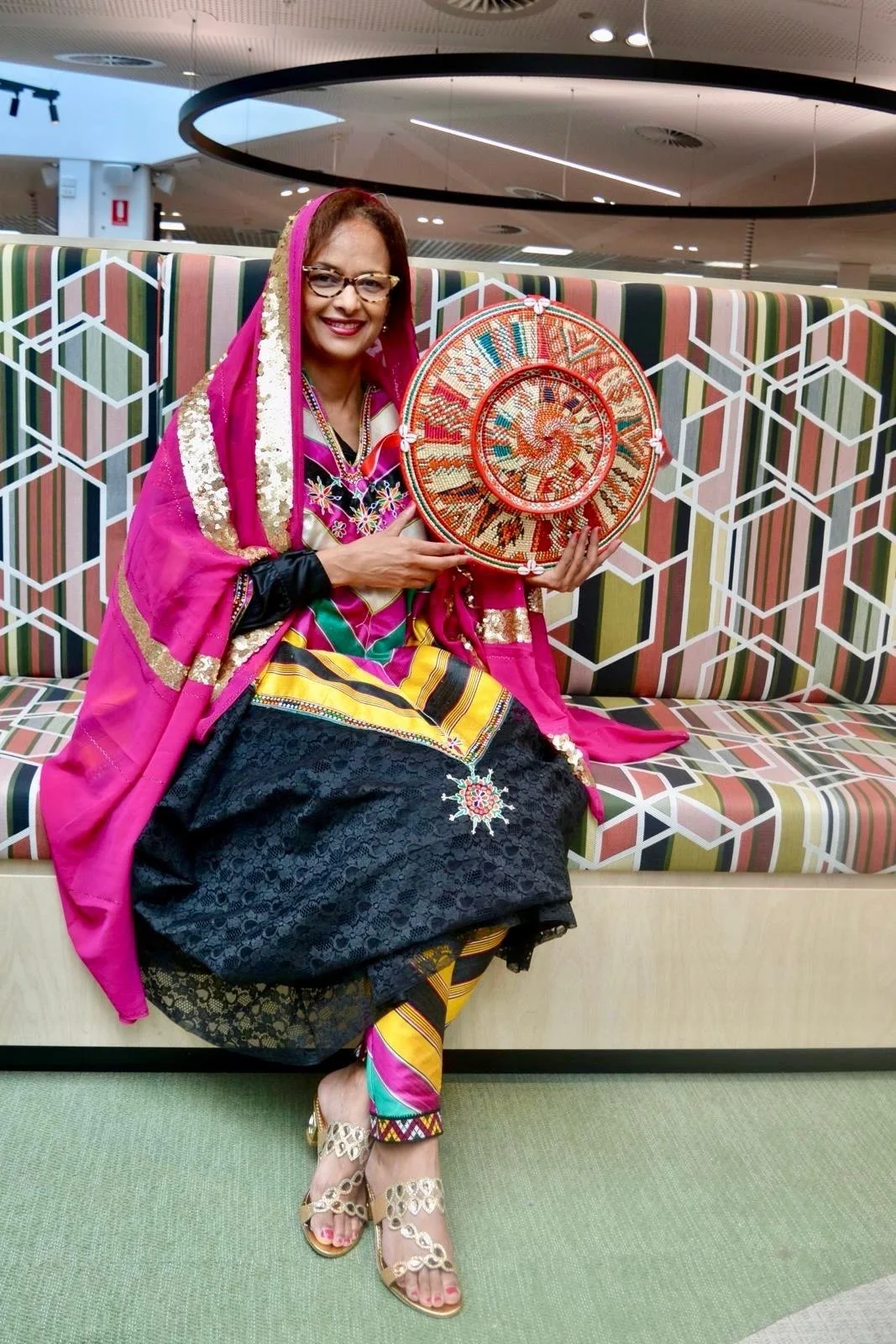
by Wudad
This story includes experiences that some readers may find difficult. Please go at your own pace, and feel free to stop reading at any time. If this brings up anything for you, support is available here.
Part 1.
Introduction
Dear reader, where should I start to tell you my
story? I could start with the deep, dark and fading
memory of my childhood and living with the impact
of Female Genital Mutilation (FGM)
Or should I start by sharing my story as a migrant
Australian women who has lived in Australia for
over 30 years and how I feel about it?
Since all three are interrelated, let me start with
the question of what is FGM in this context?
The world Health Organisation’s definition of FGM
Is: the harmful practice involving the partial or
total removal of external female genital organs,
for non-medical reasons. It has no health benefits,
it is well recognised as a human right violation.
If you already know it or if you are one of the
people who have experienced it, it is still worth
while to pin point the definition of it, so that we
know what we are exactly discussing. I will be
using FGM as an abbreviation to highlight the
severity of this cultural practice.
Some of the other names for this practice are
Female Genital Mutilation/Cutting (FGM/C),
Female Genital Cutting (FGC). Giving the harmful
cultural practice a less severe name won’t help
to eradicate it. Cultural rights cannot have rights
over women’s and girls’ rights.
Part 2.
Let Zoom in- the environment: where, when and What?
I was six years old when I was subjected to FGM.
It was at the place called the Adam’s Apple. Given
what happened, it is impossible to forget what the
environment looked like at that time.
The front yard had a three meters high fence and
A double solid metal non see though gate to keep out
the hyenas primarily.
Between the
kitchen and the dwelling we used to live in, there
was approximately about a four metres distance.
On the right side of it, about eight
metres further away, there was a traditional house
built with stone, mud and a wooden post roof.
A lady called Auntie Khadijah was one of the seven
people who used to live in that house.
It was a weather perfect afternoon, the smell was
the heavenly Ethiopian liturgical incense (Etan)
sizzling on a small decorated clay pot. Its smoke
was spreading across room. The door of that
room was never closed during the day times.
In combination with mystic earthly smells of red clay
soil which was plaster onto the dwelling’s floor, and
the coffee shell roasting on a solid metal pan on
a wood fire, aroma cannot get better than that for me.
There were a few new things that particular day at
that place. A black, red and brown colour
welsummer breed chickens. Two of them, a hen and
a rooster, their beak’s were plugging and unplugging
on the loam soil of the front yard. A big pot of water
boiling in the kitchen.
A woven sack made from natural coarse sisal fibres
filled with rustic, ruby red clay soil that smelled so
earthy due to its high oxidised iron, was placed right
in front of the main room door just opposite
the kitchen.
The warmth of the sun was soothing my skin and the
taste of roasted chickpeas was mouth-watering.
When all of those add up, the result was a gift
of pure indulgent of senses and harmony with environment.
On the other hand, the culture was roaring to divide
girls in to cut and uncut.
I was feeding the chickens my snack, the roasted
chickpeas.
Suddenly mum’s sadden face took my attention.
She was sitting in front of the kitchen near me with
her head tilted and her tears racing down her
checks. My mum was under so much pressure to
get her cultural obligation fulfilled.
The older lady Auntie Khadijah instructed her to
stop the emotion and to trust her. She paused and
started taking again, this time she gently but firmly
assured mum that she will look after her daughter
for her as her own child, during the FGM procedure
that was about take-place within the next half
hour.
At that stage I got close to my mum and started
rubbing my head and my back on her upper arm
while my eyes was fixed on Auntie Khadijah who
was standing next to the two cute chickens.
Mum replied to Auntie Khadijah by saying “I am
going to give her a quick bath” and she picked me
up with snuggle, her arm around my waist. My
arms and my feet facing Auntie Khadijah’s way.
I was trying to adjust to see clearly while I was
subject to mum’s walking motion. Before I did,
the chickens disappeared from my sight.
The brief disagreement between my mum and
Auntie Khadijah was consolidated! Any chance of
mum rebelling against the planned procedure had
diminished right then.
Her emotion tried to protest, but couldn’t escape the cage
of culture. The culture has ready to act army members
like Auntie Khadijah.
Mum continued walking into the back room which
was used sometimes as a bath room. Its door was
through the main room that would be used for FGM
soon after. When I came out of the back room
after my bath with my favourite blue cotton dress,
all eyes were on me.
What happened?
Within a few blinks of an eye, identity called “cut female” was
given to me. The animal has delivered!
When they finished making me culturally proper, I was wrapped
in plastic table cloth and taken to the other room. The
slaughtered chickens went to the boiling water in
the kitchen. The cultural had won without being
questioned. Culture has a beautiful aspect but not
when it comes to the FGM element of it.
A moment of silence
Part 3.
Dad
There was good days in our family, those
afternoon when dad was chilling-out and so
focused on his hobby of calligraphy to the
point he forgot his surroundings. He used to stick
his tong out, sharp and upward to his nose while
he was fully immersed in his art. He is so unique
in so many ways, he is ambi-dextrous. He can use
both his hands in his calligraphy writing. He was
so creative he didn’t care about the traditional
way of doing certain things such as mixing
together different ingredients of food.
I wonder where dad was when the galling cultural
act happened to me, wasn’t he supposed to protect
me from harm? Maybe he had to choose between
bread earning and being there at crucial times for his family.
Mum was happy when dad was happy. There is
one thing I admire about my dad. It is his
egalitarian view when it comes to ethnic
diversity.
Part 4.
Mum
Mum had amazing admirable qualities with an
increasing resilience and hidden strength from her
Oromo heritage. Mum has survived every
challenge that came her way in 73 years. She died
of difficulty with breathing towards the end
of Covid-19 pandemic.
Part 6.
Childhood the joy of playing
My two younger brothers and I used to role play
and make our own toys from whatever we could
find. Such as, leftover fabrics from our next
door neighbour, who was a dress maker. They had
an antique manual sewing machine and a
charcoal iron that worked with charcoal instead of
electricity. The iron had a wooden handle and Rooster
Finial, it used to drip ash though it’s shark tooth
pattern holes.
We used to stand in-front of his door like
children singing beloved carols on Christmas eve
and ask “hairier haalee”? It means, is there any silk?
He often replied by saying “Nesu”. It means take it.
Once permission was granted we used to crawl
under the sawing machine and collect the left over
fabrics, his empty bobbins and blue white
cigarette box. My brother used to make a toy car
with it. Some of the boxes came with gold foil inside,
others with silver foil, perfect for my pretend
jewellery set making. The “Desta Candy” wraps that
came in three colours, green, yellow and red.
Those were many knots in a children’s world.
Part 7.
Unity under the razor
I met Naria in Australia at a community gathering.
Coincidentally she was the same age as me and
lived in the same suburb when we were six years
old. We talked about what things used to happen
during that time in that suburb, including FGM.
Apparently she had a vivid memory of the
incident just like me. She remembered the woman
who operated on both of us and that she was missing
a few of her upper front teeth. We both laughed.
Her cousin was there during the chat.
She added to the conversation by using a rather rude
word about the FGM perpetrator.
I understand her frustration, she also had to go
through FGM. It was an epic war on girls down south
that left an unpleasant scar on many of us. A social
determinant of health resulted in poor health
outcomes for most of the female population in
the town.
Many of us have changed our story from tragic to
change makers and devoted to work in a wide range
of programs that are aiming to eradicate FGM. We
are united for life with the same vision of ending FGM.
FGM is expected to be eliminated by 2030.
Conclusion
Part 8.
Living in Australia has given me the safety I needed
to strive to reach my full human potential.
There was many times I faced obstacles beyond an
individual to resolve. Those who can address social
determinant of health, made the decisions that were fair and
inclusive such as FGM legislation, age discrimination act.
Individuals like Kimberlee Crenshaw whom made a difference
such as the intersectional leadership.
I feel absolutely privileged to join an Australian citizenship.
Having the support has enabled me to contribute to
This amazing Australian society.
There are areas of opportunity for improvement,
specially the gender gap and first nations matter.
Given the level of Australia government commitment
I am hopeful the gender gap will close in the future.
Dear reader thank you for reading my story be part of
Story Telling for change.
Special thanks to Maha who mentored me
during authoring this story. She was incredible,
kind and sensitive during our interaction.
I also have heart-felt thanks to WHISE and dynamic
organisation Monash Health without them my voice would
not have been heard today.