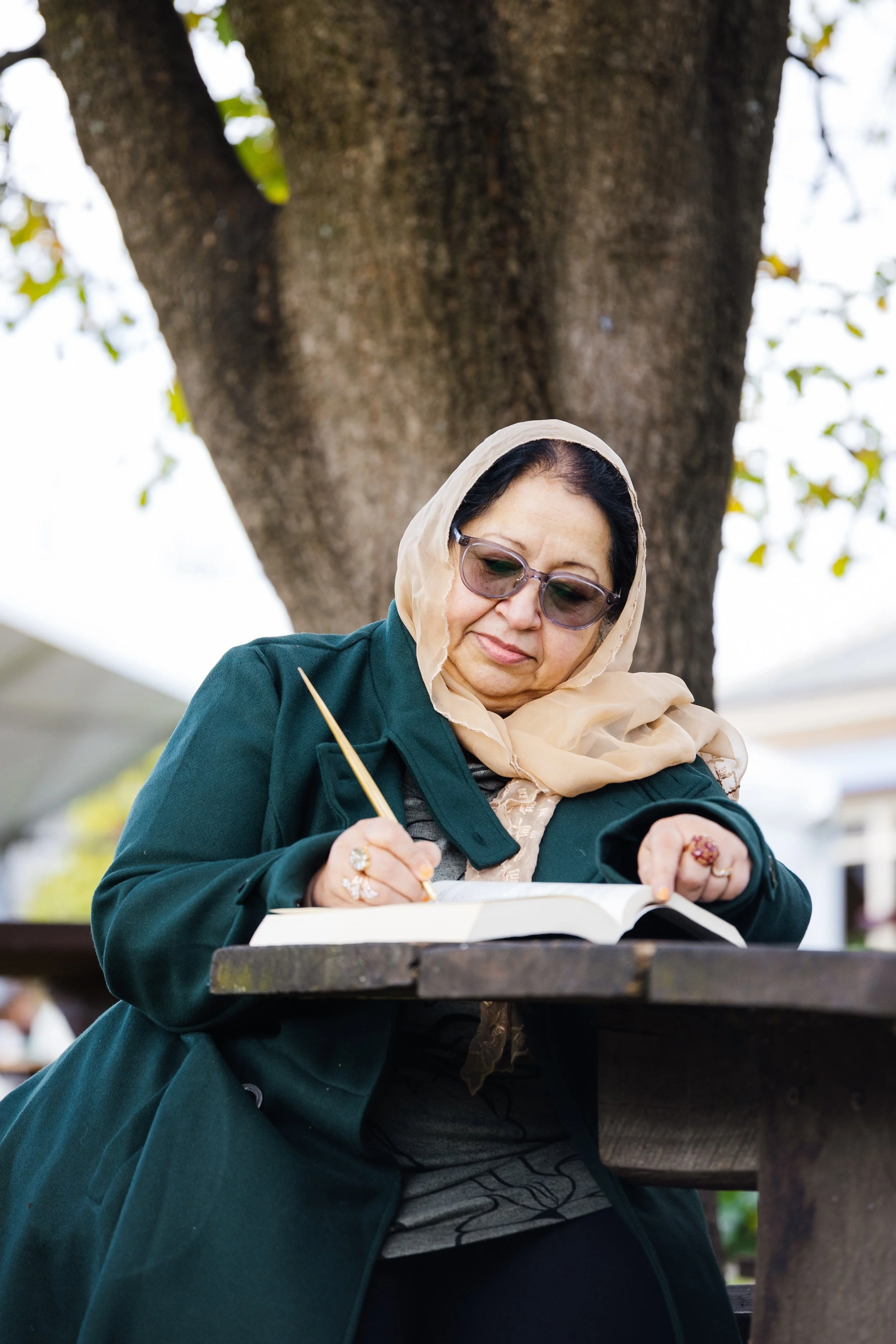
by Karima Nasimi
This story includes experiences that some readers may find difficult. Please go at your own pace, and feel free to stop reading at any time. If this brings up anything for you, support is available here.
My steps echoed as I walked down the long corridor connecting the oncology wards at Alfred Hospital. My 14 year old daughter, Fatima, squeezing my hand tightly as she smiled shyly, nervous to see her father. Portraits of doctors lined the walls, looking over us.
“I want your face to be on this wall one day” I looked at my daughter right in the eyes, her future ahead of her.
“I’ll try my best Mum” she replied, “but I can’t promise” her arms wrapped around me.
“You get there or you don’t get there, that is up to you, but that is my desire for you”.
We continued down the hallway. At this stage I was unaware of the crippling impacts that her father’s illness would have on our lives.
I reflected on my own life, and what it took to get here. My reality, very different to my daughter, and the life I worked hard for her to have.
I was born in 1956 in Kandahar, second biggest city, in Afghanistan. My family was open minded and full of care and wisdom. My father worked in the government and was a businessman. He was a big supporter of women’s rights, and my mother was a strong woman looking after my five siblings and me. She was one of the first in our community to come out without a burqa – to show her face proudly as a woman. My father was a part of the change in policy to make this possible. They valued education and even though I was a girl, they made sure I went to school.
They named me Karima. It means ‘kind and helping’. Like a good girl should be. But don’t reduce me to the stereotype of my namesake. It is my determination as strong as the Afghan mountains and my thirst for knowledge as wide as the oceans I crossed to come to Australia, that got me to where I am today.
My family planted the seed for my education, and when I got engaged at 17 and in 9th grade, my husband supported me to continue. Much to the disapproval of his conservative parents who thought a woman’s place was in the home. They insisted I wore a burqa when leaving the house to be able to continue school.
I am thankful for my husband to support me to finish school and help me achieve my dreams. He was the type of man that if I said I wanted to go to the top of the mountain – he would say ‘let’s go’.
After five years of marriage, pregnant with my third child, Afghanistan was in war with Russia, the Taliban were taking over and women’s and human rights were going backwards. Men started to ‘disappear’ if their businesses were too successful. My brother was one who was gone without a trace. My husband ran an export/import business for tea and dried fruits. But it was not safe for him to stay in Afghanistan so he escaped to India to continue his business.
For months, the bombs were going off. I could hear them coming. I can’t describe the feeling of not knowing where it would land. The sound was so loud when it crashed to the ground. Everything went silent as I was deafened for a moment….then ringing in my ears. Bodies couldn’t be buried as it was too unsafe to leave, so they had to be buried in the yards in the rubble.
One of the scariest moments of my life was crossing through the mountains of Afghanistan to Pakistan - my journey towards India to be with my husband. We were driving on the backroads, sitting in the back of the open-air Ute. The driver suddenly stopped and ran off, the car door left swinging open. We didn’t know why. We heard it first and then we saw it. A fighter jet heading directly towards our car. We knew it was the end. We held onto each other tightly, the kids crying, all of us crying.... praying. Somehow, God was on our side in that moment. The plane came closer and closer and then before crashing into us, changed directions and flew off. We couldn’t understand what had happened. Were we alive?
The driver returned.
“Why did you leave, you left us?” we asked.
“I had to run for my life, there was not enough time and the kids would have been slow,” he replied before getting back into the car to continue.
Then he took us on to Quetta and from here we safely flew to India to be with my husband. I was so worried for my parents return through the same mountain range – Inshallah they were safe.
It was a hard and lonely time so I joined my husband in India, with two young girls and pregnant with our third. My girls started school and I was at home with our baby boy. But I was bored at home and wanted to finish my education. My husband supported me with a tutor where I studied English for five years.
Another child later, life was getting harder because the situation in Afghanistan was getting worse and worse and running the business was even harder to manage. Change of Governments, fighting between government and Taliban. No school, Russia was still invading. Businesses were crashing all around us and we felt the impact from our new home in India. Life was unsustainable in India and it was not safe to return home, so we applied to live in Australia. We were sponsored by a church.
We arrived in Melbourne, in 1987, my youngest was 7 months old. The church gave us a house in Preston to live in. The three kids started school and I was busy with my youngest daughter at home.
I felt very lonely. India and Afghanistan are still very alive with a big sense of community. In Australia, I don’t even know my next-door neighbour. Taking children to school, I would look around and it was dead. No one spoke to each other. I had no friends or relatives.
On the brighter side, I knew the language, but what good is that if there was no one to talk to?
My husband worked in an industrial fabric factory. My kids into kinder and school and I started working at a sewing company as a machinist making underwear. We worked hard and after two years were able to buy a house in Hampton Park. Travelling so far to work and juggling school pick-ups and childcare became too much so I had to give up my job.
Staying at home was no good for my mental health or our finances. I wanted to do something with my life beyond being a wife and a mother. I did a business course and I took to it naturally as a kite catches the wind above Kandahar. At the time we did not have computers or internet, and I knew little about starting a business in Australia. But when I discovered the Dandenong market my eyes lit up and I knew in my heart this was where I needed to be. I would start a clothing business.
The seed had been planted and through hard work and determination, (and many phone calls to wholesalers found in the Yellow Pages), I opened my first business.
It is amazing how much one table of clothing created such a feeling of excitement. I progressed from folded clothes on a table, and built my small castle with clothing racks where the clothes hung. It grew from, one, two to three tables – starting with men’s clothes, and then into women’s clothings....adding all the colours of the rainbow. I enjoyed the thrill of designing the space to catch people’s eye and draw them in.
Over 20 years, I went from a single table in a market to opening 17 shops across Melbourne, Adelaide and Tasmania with 35 staff.
I came to Australia with one suitcase, and within this time my turnover was one million dollars.
On top of this I had a fifth child so you can imagine the juggle. I was able to do it as my husband shared the care of the kids and ended up working with me in the business. I loved my job as I was all the time talking with women. Talking, talking, talking. I loved the competitive nature of selling. I would have a friendly competition with my husband about who could sell the most.... Of course, I usually won.
Life was good. No one would have imagined the struggles I came through to get there. The war, the displacement, having to leave our families for safety. I was finally myself. I was happy.
But everything changed when my dear husband became sick. The downturn had arrived. As my husband’s needs grew, my world started to shrink.
I had to start closing my stores as I was not able to keep up with the management required. With every closing, I felt like I lost a little bit more of myself. My strength. My independence. One by one, they closed. I felt empty like a market stall after the crowds have gone home.
When I lost my husband, the grief was too much. I couldn’t carry it all. I was supporting my five kids who were older now, the oldest 45 years, and the youngest still at Uni…. I was the mum taxi and supporting them to achieve their own dreams.
Losing my husband, losing my businesses, losing my mind. My kids encouraged me to get back out there, and this is where my community work as a volunteer increased.
Over the last ten years I have completed a community leadership course, joined gender equality and prevention of gender-based violence groups for the City of Casey and now Women’s Health in the South East. I have volunteered for SMRC and Wellsprings for Women supporting refugee and migrant women and I have been a support person for Cancer Connect Australia. I am currently the board member for Shagofa organisation, supporting newly arrived refugee’s and am a leader in my community. I am also supporting Afghan women for the Ethnic Community Council of Victoria.
In 2020, I had the honour of being ‘Australian of the Year’.
In these roles I work with women to overcome barriers, and to influence changes in policy and practice, so that women can thrive and be free.
Over the years in work and volunteering, I have learned a lot. If there is advice I would give to women, particularly newly arrived refugee’s it would be this:
“There are so many of opportunities, find something that works for you and work out what is the best for you, and go for it”.
‘Be friendly, life is very short’.
‘If you have a goal in your life, work towards it to achieve it.’
‘Never take no as an answer.’
These lessons I have instilled in my own children who are all successful. I also pass them on to the women I work with.
And if you are wondering what happened to that little girl that I walked down the hospital hallway with many years ago…I can proudly say she is now a doctor.
10 June 2006