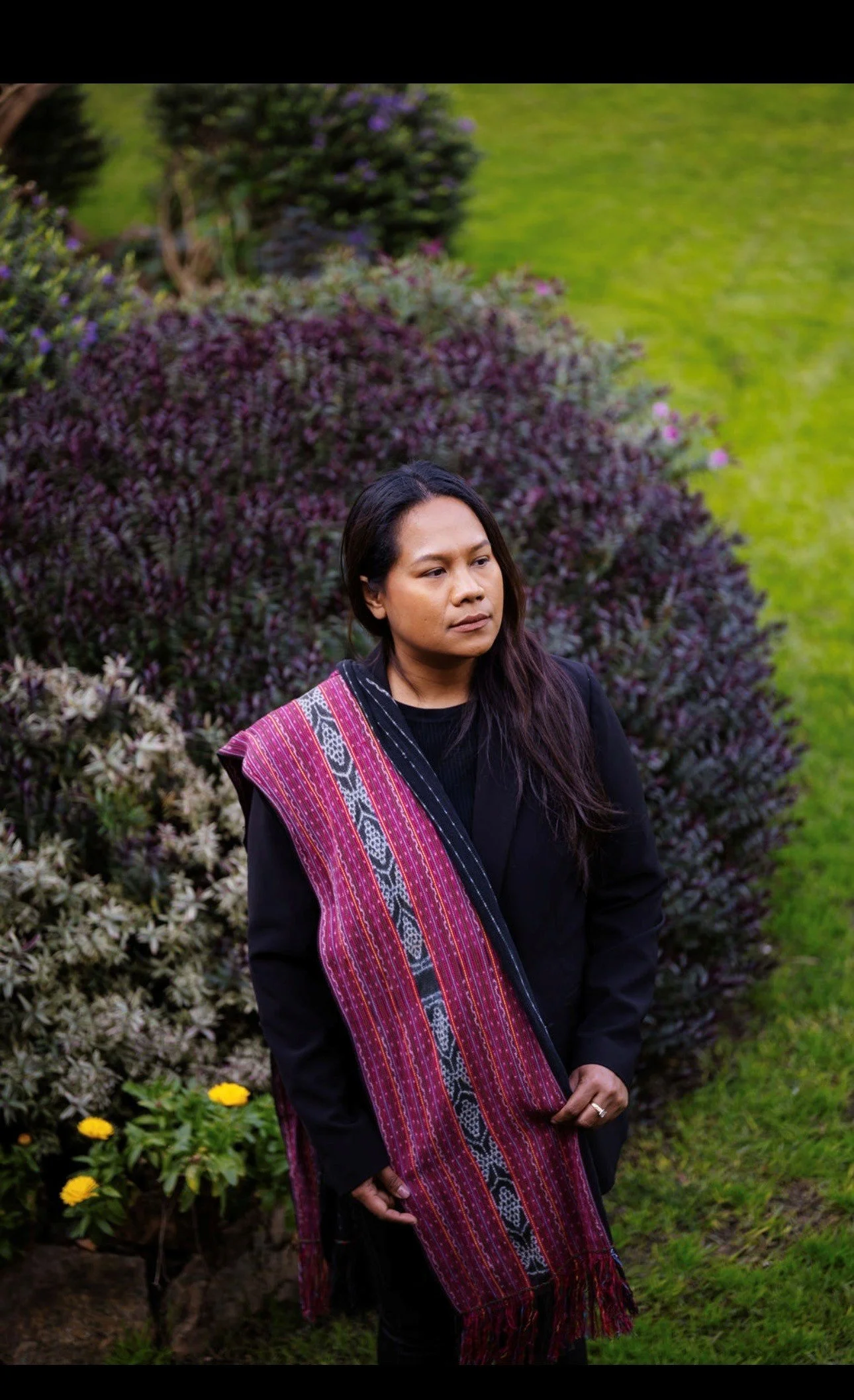
by Elisabeth Moniz
This story includes experiences that some readers may find difficult. Please go at your own pace, and feel free to stop reading at any time. If this brings up anything for you, support is available here.
Good morning from Rooster and Frog
My father worked as a public servant during Indonesia’s occupation of Timor Leste. My mum graduated with a teaching diploma. She never worked as a teacher under Indonesian occupation because of both not completing a practical component of her degree and having five kids. I - Elisabeth am the oldest. I have one younger sister and three younger brothers.
I went to a primary school near our village of Bairro Pite on the outer of Timor’s capital Dili. My father used to drop me off and pick me up with his motorcycle. We owned a taxi too, so sometimes he would drop me in the taxi if he was around my school when I finished. Life was simple. In the morning, mum prepared me. I can still remember the baby powder she sprinkled on me before going to school. I remember waking up with the sound of spoon hitting the glass because my mum was mixing the tea with the sugar. We always had bread and tea mixed with sugar. The sweeter it was, the better.
Morning usually started with the sound of the Rooster and if it was rainy season, Frog would always join in the early morning noise. They would usually stop when the sun came out. I hated the sound of frog in the morning because I am actually scared to see their big eyes. The Frog would always begin singing again like a choir when the sun is down.
I always looked forward to going to school every day because I was a good student. I would always get good grades (number 2 in the class because I could not beat the smartest girl in the class who was from Indonesia). But my parents were still always so proud of me every time they got my end of year report. I started the day with a shower and always got new shoes, books and a haircut for the new semester.
Even if I asked for a bike, my parents would get it for me. My favorite time of the year was Christmas. People would come to our house and there would always be food, cakes, Fanta and coke available all day. We never miss Katupa, my favorite rice treat wrapped in coconut leaves and cooked in coconut milk.
I was in fifth grade when everything I knew changed. In 1999, the capital city Dili started to become more crowded with lots of white cars with the letters UN on it. Most of the people who drive the cars looked like people in the movies. They are from all over the world. I didn’t know it then, but this was lead-up to the historic 1999 referendum where the people of Timor-Leste got to vote for their independence.
Timor Leste was occupied by Indonesia for 24 years. Indonesia invaded Timor in 1975, taking over from the Portuguese colonists. I was born in 1988 during the Indonesian occupation.
As a child seeing different people was one of my favorite things to do. In the afternoon after school, I would take my youngest siblings to the street near us and wave at the UN cars. If my uncles were not available, I would ask my youngest siblings’ nanny to take us to wave at the passing UN cars. The foreigners always waved back. That always made our afternoons even better.
The road to referendum and Independence
We officially got our independence from Indonesia in 2002, but it was a long road to that point. The Timor Leste people had overwhelming voted for freedom from Indonesia in the referendum of 1999. Jubilation gave way to increased violence and Indonesian military presence in Dili. I was eight years old when the country experienced burning and riots in 1999.
During the lead up to the referendum what I can remember the most was the demonstrations. We were not allowed to go to school. It was considered very dangerous because sometimes the Indonesian military and the pro-Independence demonstrators clashed. Near our house we could hear screams, multiple gunshots and I could feel my eyes burning from the tear gas. Now looking back, I could not believe as young as eight I knew what tears gas felt like. It was a hell of a pain for a child’s eyes. I could not forget the first time when it happened. I can see everyone running away but the gas was already close, and I ended up with swollen eyes.
September 4, 1999, was the day the referendum result was announced. We watched it on TV. My parents and my uncles were so happy, jumping. I know why they are happy because we got independent. I was a bit upset, because I could not watch TV and my favourite cartoons.
At end of the year, I got gifted brand new shoes I had always wanted, the ones I saw from the TV commercial. I was ready to wear it to school, but we never went back. I overheard my father telling my mum that he no longer had a job because he doesn’t want to move to Indonesia or transfer. He chose to stay in town and vote in favour of the referendum. From this point on, it’s my mother who becomes the hero of our family and helps us survive.
Gunshots that sounded like popcorn
The next few days after the referendum things get worse as Indonesian troops move into the streets. My mother started to stock up on boxes of noodles and sacks of rice. Every night we slept on the floor while gunshots go off. It sounded like popcorn popping from distance, as if whoever is making popcorn has a big batch. The popping sound started and stopped for a while and then started again. One night the faraway popcorn sound started to become a very loud one that made you feel like you are sitting next to the gun. The night became really scary. All we can do is pray and hold each other hands in a small circle, while lying down on the floor. We were too scared to stand up. My knees were shaking uncontrollably and I could not stand.
Our family left our village to go to a refugee camp near our place. We were told it was safer. If we run to the Indonesian police station, we might be transported to the Indonesian border. If we go into the forest and hide, my two youngest twin brothers who are still on formula wouldn’t survive. We decided to take refuge in the nearby refugee camp guarded by Indonesian militia. This was strangely safe because some of these lower grade militia helped us and did not really want to be there. We stayed there for a few nights. Our nightmare ended on September 20, 1999, when Australian peace-keeping forces arrived in Timor Leste.
Coming back home after war
When we returned to our town, we see so many houses destroyed. Luckily our house and others in our village had not been touched. Nearby village homes were burned down. We can smell the houses burning nearby.
Now we survived from the scraps in the mess. What I always looked for in the rubbish and destroyed buildings were books. Because there is no more TV, it is the only source of entertainment for me. I found one Readers’ Digest in the pile of garbage. People are looking for food, but I was walking around to look for something to read. We have no TV, not even radio or books we can read. I had that one Reader’s Digest in English from the war debris, and I kept looking at it. I memorised the words even though I do not know how to read it properly because it is in English.
I felt safe when I saw the Australian peacekeepers, even if they walked around with big guns. I saw them as heroes. I learned to practice my English with them. The first English lesson that I could remember was, you have to say, ‘how do you do’, to people you first meet. I kept saying, ‘Hello Mister, how do you do?’ to passing Australian soldiers. For some reason they answer my questions. I was so proud of myself.
Back to school
When school starts again it’s one of the most exciting days of my life. I can finally go outside and walk to school. It takes a few days to get used to walking to school. I was put in the sixth grade.
I was so excited to learn and one of the subjects I was good at was languages - English and Portuguese. I’m also fluent in Bahasa Indonesian and my native Tetum.
But now the shoes that I got before the 1999 war do not fit anymore. I had to use the slippers to go back to school. I remember we went to school with no uniform and slippers. I did not even own a bag or books.
In the period after the referendum but before independence, poverty is rife.
‘You either chose a full belly or school’
At home, I have to look after my younger siblings so my parents can find food and my father can look for a job. We survive on foreign aid. Sometimes I have to stay at home and go to school around 10am because my parents need to queue for food and supplies from UNHCR or UNICEF. When they arrive home only then I can go to school.
Sometimes UNICEF comes to our school to give us the ‘BP100’. I think it is one of the most delicious cookies I have ever had. Maybe it tasted so good because that is the only treat I have had for a while. That aid biscuit that staves off malnutrition was one of my favourite to eat. Sometimes they give us a type of sweet - pounded corn or maze. It is so good. When you mix it with hot water it could transform into porridge. If you eat it you are set for the whole day.
My mother makes sure we do not go hungry. She rationed our food daily with the humanitarian beans that the UN provided. My parents get them when they go to queue in the morning in the nearby post office.
Our food contains rice, boiled red beans, and a vegetable my mum grew in the backyard. We call it Kanko. It is kangkung or water spinach. I still love that vegetable.
Once the foreign aid stopped, my parents go looking for food in the town with the neighbour. My parents told me they have to leave my younger siblings with me because the neighbours are taking them to find the nearest food supplies at the far end of the town. I have to stay home that day. From a young age I understood the assignment. You either chose a full belly or school. I stayed with my younger siblings and try to entertain them with scary stories I knew.
Mum gets a new job
My mum started to walk barefoot selling popsicles where my three siblings’ studied in primary school to make money.
Mum still had her diploma from teacher training. By luck, one of her friends from teacher training saw her selling popsicles and invited her to present herself to the headmaster because they needed a teacher to replace one of the teachers who had been transferred to the junior high school.
My mum didn’t even own slippers. She borrowed some, tied her hair back really tight and went into the meeting with the headmaster with confidence.
She went in and got the job. Her first paycheck as a teacher was $40 per month. I never knew she sacrificed that much to feed us. I only found out later she walked barefoot selling popsicles. It makes me more grateful for my super-mum. She taught me that we need to be tough. She finally completed her full teaching degree with practical, when she was 45. We are so proud of her achievement. She is the only daughter in her family to get a degree
Mum worked casually as a teacher in a role that fits the lesser qualifications she has. I was going to school on time because all my younger siblings also went to school. I felt free. School for me is the way I can learn.
Sometimes I wished I was born male; I hated being a woman.
I am always excited to go to school, as that is the only entertainment I have.
Sometimes I wished I was born male; I hated being a woman.
When I hit puberty, I felt like my world ended. We can’t even afford new underwear let alone pads. I remember the day I got my period because we could not afford to celebrate new year and we were just eating bean and rice. It was January 1, 2000. My mum was so worried she took me to my room and asked, ‘what happened?’
All I can say is “ran” which means blood in tetum. I could not utter another word to my mum. I can smell rain touching the floor, and I felt so sad that day. Sometimes I wished I was born male, I hated being a woman.
Mum hugged me tight and said that she promised when she has more money, she will give me fifty cents every month just for my period pad. Her promise makes all my problems wash away with the rain that day.
When my mum promised me fifty cents every month, I know that she could not give me the fifty cents she has right now because she needs that to feed us for another week. I can feel my cheek wet from her tears that night. I just fall asleep on her lap.
After getting my period, going to school started to become very hard for me. When I sat down, I could feel that my skirt is wet and I had to stay in class and be still at my desk because I knew that there is period blood on my skirt already.
I had to use my own underwear and as a pad. I walk slowly and carefully because if I run the makeshift pad could fall out. It was one of the hardest things to do every month.
Plus, there are no working toilets or running water at school. Sometimes when you are lucky you have an actual desk. Sometimes you come to school, and the school is full of goats and no chairs, and you have to sit on the floor. I was always excited to go to school. I only hated the logistical inconvenience of getting my period. I used to stare at myself and ask, ‘Why do I have to be a girl? Why can’t I be a boy? They don’t have to worry about buying bra and pads!’
We could barely afford food let alone those pads and bras. I was so sad to realise that I will now have a period every month.
My mum now had a bit of income now to feed the five of us with her casual work as a teacher along with an extra side hustle of selling vegetables in front of our house. She kept her promise to buy me a pad every month with the extra money. She always provided us with food on the table, and she never let us starve.
She worked so hard. With the money she collected I was eventually able to go one of the city’s best boarding high schools. This decision, and her love and sacrifice changed my life.
Boarding school and heading overseas
I knew I wanted to get an exchange scholarship to Brasil. It was competitive and my preparation was intense. I consulted my uncles who can speak English, waited for them after school in their front yard just to listen to their advice. I went to my aunty’s house just to ask for interview skills. I wrote it down in piece of paper, back then I did not have any access to internet, computer, or printer. I finished school and queued in the local internet Kafe just to type my answer for the interview. I barely got any lunch money, so I aimed for free services. One of my favorite places to go is to queue for a free printer and one hour internet. No matter how hungry I am I went to queue there to print and type after school.
I usually, on a good day, had 25 cents. I had 10 cents for a return trip to the new fancy high school my mum sent me to, featuring with student boarders and the country’s elite. I went on a local minibus we called Bemo. I had 10 cents for breakfast and 10 cents for lunch.
We would finish at three and afterward I would start walking to the world bank office to use the internet. I even worked there years after.
For my first interview ever, I borrowed shoes from my friend I do not have good shoes for interview. My aunty gave me one of her formal shirts and my childhood friend and neighbour lent me her best skirt. It was the only outfit she had for church. I remember three of my borrowed outfits were all light brown, they all matched. I still thank my friend who lent me the shoes. I always visit my her if I go to Timor, her house is one of the house I must visit even if it is just to say hi.
I got the scholarship. I remember flying to Darwin to induction - my first time on a plane. I was so nervous and excited. I eventually finished my grade 12 in Colegio Marista, Cambuci Sao Paulo, Brasil, living with a wonderful host family where I was exposed to Brazilian high society and school friends with credit cards and endless freedom and resources. I was Aluna destaque - outstanding student of the year. I eventually even got a competitive scholarship to Australia. The Australian Award Scholarship to study at La Trobe University in 2013. I went on to successfully get scholarships from MEXT Japan to complete my master’s degree in international development at Nagoya University. Today I work for an international development company based in Australia
Today every month I set a reminder set in my phone. It says, ‘Remember your old room’.
I stay connected with my past not to pity myself that I was very poor, but to remember how it made me who I am now. It keeps me grounded that nothing comes easy in life, you have to work hard to get it.
When life is hard, I try to look around and bring myself to my old childhood dirt floor room. I still the smell of earthy smell of my room. Every time I needed to study I had to sprinkle water and use the broomstick to clean the room to keep the dust and debris away. I had to wash my feet clean before reading in bed. I did not have any desk or table. All my study equipment was in my tinny bag and on my bed. I just wrote and studied there.
Today every month I set a reminder set in my phone. It says, ‘Remember your old room’.
When I see that, I spend a few moments meditating on my journey. It helps me stay focussed on my purpose - to not just work, earn money and relax but to continuously contribute meaningfully to society.
When things are hard, I remember all I’ve overcome and how far I’ve come.
When things are hard or obstacles appear in life, this reminder of the earthy smell of my room helps me remember all I’ve overcome and how far I’ve come. It keeps pushing me to work harder to achieve what I want in the world and reminds I can keep going.
In my old house after the war, even the wall started to produce what we call wall salt. A random white line making its way as if it is an undiscovered world map on the wall.
Every rainy season my feet would be wet when cooking, and washing dishes becomes a nightmare. Even walking around is a hazard, we can fall anytime because the water is everywhere. I vowed to make Mum a big house when I could afford – one where we are not going to have our feet wet in the rain and no more cooking while in wet clothes. I wanted a house high enough so we could be able just watch the rain from the window, just like in the movies. You know those romantic movies when you are wet and crying? That was us. But the difference is our feet and clothes were wet and we’re not crying, but actually cooking, washing dishes, or moving dirty plates to the nearby well.
Recently I made good on that promise. My four siblings and I (who are all educated like me) banded together to buy my parents a decent house to live. Today they live comfortably in Timor, and now they can just watch the rain from the outside just like in the movies.
My story does not make me a victim. My story does not make me feel like I have conquered the world or make me a perfect person to tell others about life. The lesson I can take is to stay grounded and grateful. For me my past is a pathway for me to look forward. I take only what makes me strong, I chose to forgive the rest, from there I build the future I want to have.
Elisabeth Moniz lives in Melbourne with her husband and two kids.